




Insurance adjusters use two main formulas to put a dollar figure on pain and suffering: the multiplier method, which multiplies your medical bills and lost wages by a number between 1.5 and 5, and the per diem method, which assigns a daily dollar rate to every day you lived with pain. Neither formula is required by law. Both are negotiating tools, and which one gets used (or whether you can even argue one in court) depends partly on which state you’re in.
If you’ve just gotten an offer from an insurance company and you’re staring at a number with no idea how they landed on it, you’re not alone. Most people never see the math. This article walks through both formulas, where they came from, and why one state’s courtroom rules can be completely different from another’s.

The Multiplier Method Multiplies Your Bills by a Pain Factor
This is the formula most insurance companies default to. First, they add up your “special damages,” meaning your medical bills, lost wages, and any other costs you can point to a receipt for. Then they multiply that total by a number, usually somewhere between 1.5 and 5, meant to reflect how much pain and disruption the injury caused.
A minor sprain that healed in a few weeks might get a multiplier close to 1.5. A herniated disc that needed surgery and left you with permanent restrictions could push the multiplier toward 4 or 5. The number isn’t fixed by any statute. It comes out of negotiation, and it’s shaped by things like how well-documented your treatment is, whether liability is clear, and how a jury in your area has historically valued similar injuries.
If you want to see how this plays out with real numbers plugged in, the pain and suffering calculator guide walks through the math step by step.
The Per Diem Method Pays You a Daily Rate for Each Day You Hurt
The second approach skips the multiplier entirely. Instead, it assigns a dollar amount for each day you experienced pain, then multiplies that daily rate by the number of days you’re expected to suffer, from the accident until you reach maximum medical improvement.
The daily rate itself is the sticking point. A common (though not universal) approach is to anchor it to something concrete, like your own daily wage, on the theory that a day spent in pain is worth at least as much as a day spent working. But there’s no formula that tells you what that number should be, which is exactly why some courts have been uneasy about letting attorneys use it in front of a jury.
A 1958 New Jersey Case Banned Per Diem Arguments in the Courtroom
The per diem method has a specific legal history worth knowing, because it explains why your state’s rules might differ sharply from a friend’s in another state.
In Botta v. Brunner, a 1958 case, the New Jersey Supreme Court ruled that a plaintiff’s attorney could not suggest a per diem dollar figure to a jury when arguing pain and suffering damages. The court’s reasoning was straightforward: pain has no fixed price, there’s no market where it’s bought and sold, and putting a specific formula in front of a jury creates the illusion of precision where none exists. New Jersey’s rule became the model that several other states adopted, sometimes called the “Botta rule.”
That doesn’t mean per diem thinking disappeared from New Jersey settlement talks. Attorneys and adjusters can still use it privately when negotiating a settlement. New Jersey’s model civil jury charge on pain and suffering damages simply tells jurors to award “such amount as you believe will fairly and reasonably compensate” the injured person, with no formula attached.
California Went the Other Way and Let Juries Hear the Daily Rate
Not every state agreed with New Jersey’s approach. In 1966, the California Supreme Court decided Beagle v. Vasold, and reached the opposite conclusion. The court held that attorneys could suggest a per diem rate to a jury, reasoning that a jury given no guidance at all is just as likely to guess arbitrarily, and that a per diem argument, so long as it’s clearly labeled as argument rather than evidence, gives jurors a useful starting point rather than a false one.
Today, most states follow something closer to California’s approach, allowing per diem arguments with some safeguards, while a smaller group of states still hold to a version of the Botta rule. That’s part of why the same injury can settle very differently depending on where the accident happened. Our guide to minimum insurance and fault rules that vary by state covers other ways your state’s law shapes your claim.
Example Scenario: Same Injury, Two Different Formulas, Two Different Numbers
This is a fictional example for illustration only, not a real case.
Imagine Maria breaks her wrist in a rear-end collision. Her medical bills and lost wages total $12,000, and her doctor says she was in significant pain for about 90 days before her wrist healed.
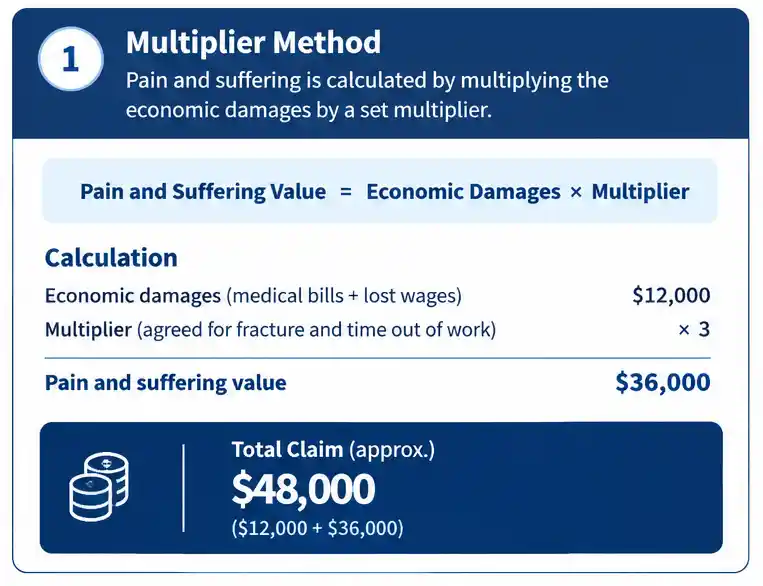
Under the multiplier method, if the parties agree on a multiplier of 3 given the fracture and the time out of work, her pain and suffering value comes out to $36,000 ($12,000 × 3), for a total claim around $48,000.
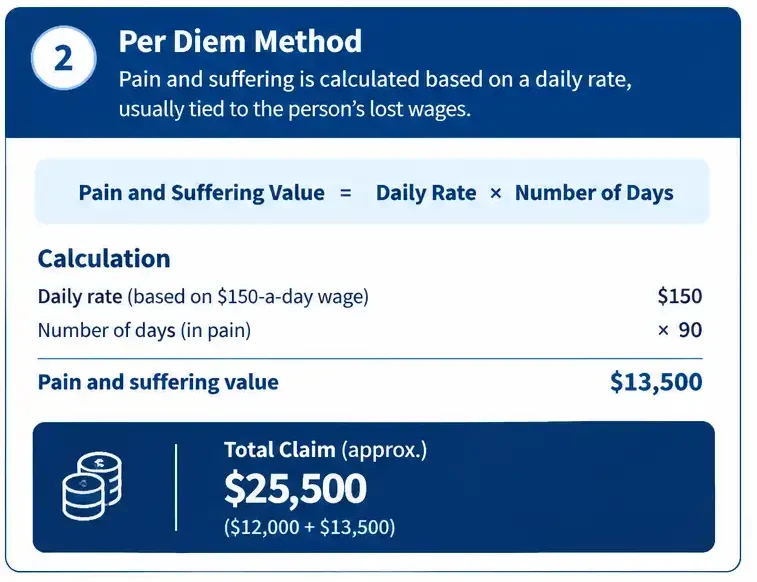
Under the per diem method, using a daily rate tied to her $150-a-day wage, the pain and suffering value comes out to $13,500 (90 days × $150), for a total claim around $25,500.
Same injury, same person, two very different numbers.
This is exactly why the choice of formula matters so much in negotiation, and why insurers tend to favor whichever method produces the lower number for a given case.
Under the multiplier method, if the parties agree on a multiplier of 3 given the fracture and the time out of work, her pain and suffering value comes out to $36,000 ($12,000 × 3), for a total claim around $48,000.
Under the per diem method, using a daily rate tied to her $150-a-day wage, the pain and suffering value comes out to $13,500 (90 days × $150), for a total claim around $25,500.
Same injury, same person, two very different numbers. This is exactly why the choice of formula matters so much in negotiation, and why insurers tend to favor whichever method produces the lower number for a given case.
Which Method Actually Fits Your Injury Depends on How Long the Pain Lasted
Neither formula is objectively “better.” They tend to fit different situations.
The multiplier method usually works in your favor when your injury is severe but recovery is relatively quick, since a high multiplier applied to a modest bill total can still add up. The per diem method tends to work better for injuries involving a long, well-documented recovery, because the daily total accumulates over months, sometimes outpacing what a multiplier would produce.
An experienced attorney will often run the numbers both ways before deciding which one to lead with in negotiation. If you’re unsure which approach fits your situation, speaking with an attorney before you accept an initial offer can help you understand which formula the adjuster used and whether it undervalues your claim.
What to Do Before You Accept Either Number
A few practical steps matter more than which formula gets used:
Keep a pain journal. Whichever method comes up, documented, dated notes about your pain levels and how they affected your daily life make either formula easier to justify.
Don’t assume the first number is the only number. Insurance adjusters often start with whichever method benefits them, and there’s usually room to negotiate.
Ask which method the adjuster used. If they won’t say, that’s worth noting. You can run your own estimate using the injury settlement calculator to get a starting point for comparison.
Once you understand your state's filing deadline, the next question is usually how much your claim is worth. Insurance adjusters typically lean on one of two formulas, the multiplier method or the per diem method, to price pain and suffering, and knowing which one applies in your state can change your negotiating position significantly.
Frequently Asked Questions
Does every state allow the per diem method in court?
No. States are split. A handful still follow a version of New Jersey’s 1958 rule against suggesting a per diem figure to a jury, while most others allow it with certain limits, following California’s approach.
Can I use both methods and pick whichever gives me a higher number?
You can calculate your claim both ways to see which better reflects your situation, but a single settlement negotiation typically centers on one method at a time, not both added together.
Does the insurance company have to tell me which method they used?
No, and many won’t volunteer it. Asking directly is reasonable, and their answer (or refusal to answer) can tell you something about how they arrived at their number.
Is a higher multiplier always better for me?
Generally yes, since a higher multiplier means more compensation for the same economic damages. But the multiplier itself has to be justified by evidence of your injury’s severity and impact, not just requested.
What happens if my pain lasts longer than expected?
Under the per diem method, a longer recovery period increases your total. Under the multiplier method, a longer or more complicated recovery may support arguing for a higher multiplier instead.
Do lawyers ever use a completely different formula?
Some attorneys and insurers use software-based valuation tools that blend multiple factors, but the multiplier and per diem methods remain the two most commonly referenced starting points.
Research & Sources
- Botta v. Brunner, 26 N.J. 82 (1958): https://case-law.vlex.com/vid/138-2d-713-n-619935343
- Beagle v. Vasold, 65 Cal. 2d 166 (1966), UC Law San Francisco Repository: https://repository.uclawsf.edu/traynor_opinions/326
- New Jersey Courts, Model Civil Jury Charges – Damages: https://www.njcourts.gov/charges/damages
