




Pain and suffering damages are calculated primarily through the Multiplier Method, which multiplies total economic losses by a number between 1.5 and 5 based on injury severity. Alternatively, the Per Diem Method applies a daily compensation rate across your recovery days. Final payouts depend on medical documentation, daily lifestyle disruptions, and treatment consistency.
Every year, thousands of people search for a pain and suffering calculator after an accident. They have medical bills and lost wages tangible numbers they can add up. But the physical pain, emotional distress, and disruption to daily life also have value. These are known as non-economic damages, and they are a critical part of any personal injury claim.
Our guide explains how is pain and suffering calculated by insurance companies and legal professionals. It also allows you to use our free calculator to get an instant, data-driven estimate based on common industry formulas.
What Is Pain and Suffering in a Personal Injury Case?
In legal terms, “pain and suffering” refers to the combined physical and emotional injuries a victim endures after an accident caused by someone else’s negligence. It is a form of non-economic damage.
Economic Damages: These are direct financial losses with clear monetary values. Examples include medical bills, prescription costs, lost income, and property damage.
Non-Economic Damages: These are intangible losses without a specific price tag. They cover physical pain, emotional distress, anxiety, depression, loss of enjoyment of life, and permanent scarring or disfigurement.
While you can’t show a receipt for anxiety, this suffering is a real and compensable part of your claim. For how this fits into your total settlement, see our Compensation & Settlements guide.
Compare the Multiplier and Per Diem Calculation Methods
There is no single, official formula. However, insurance adjusters and attorneys commonly use two methods to arrive at a starting figure for negotiations.
Apply the Multiplier Method to Total Economic Damages
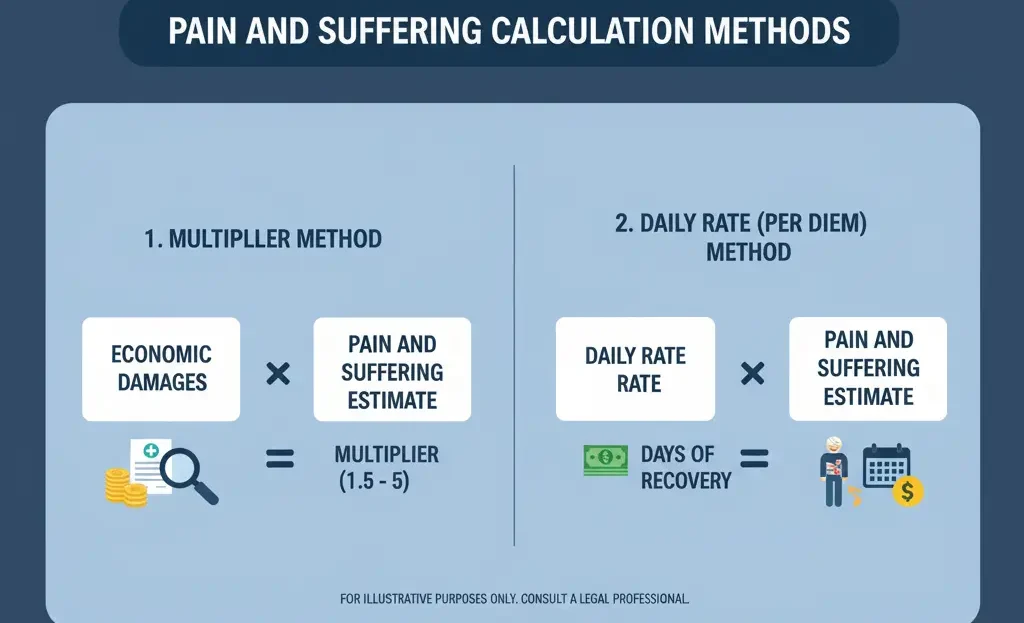
This is the most common approach. The formula involves totaling all economic damages and multiplying them by a number between 1.5 and 5.
Formula: Total Economic Damages × Multiplier (1.5–5) = Pain and Suffering Value
The multiplier number depends on the severity of the injuries.
1.5–3: For minor injuries with a quick recovery (e.g., whiplash, sprains, bruises).
3–5 (or higher): For severe, long-lasting, or permanent injuries (e.g., traumatic brain injury, spinal cord damage, permanent scarring).
Example Calculation:
You were in a car accident and your total medical bills and lost wages (economic damages) are $10,000.
You suffered a broken arm and whiplash, requiring several months of physical therapy. Your case might warrant a multiplier of 3.
Calculation: $10,000 × 3 = $30,000 in pain and suffering.
Your total initial demand would be $10,000 + $30,000 = $40,000.
Calculate Daily Rates with the Per Diem Valuation Method
This method assigns a daily rate to your suffering. The rate is often based on your daily earnings before the accident, arguing that the effort of dealing with an injury is comparable to the effort of working.
Formula: Daily Rate ($) × Number of Days of Recovery = Pain and Suffering Value
Example Calculation:
- You earn $200 per day at your job.
- Your doctor states your recovery from an injury will take 90 days.
- Calculation: $200 × 90 = $18,000 in pain and suffering.
This method is less common and typically used for shorter-term injuries with a clear recovery timeline.
Identify 5 Key Factors That Drive Settlement Value
How do insurance companies calculate pain and suffering? They look at specific evidence to determine the multiplier or justify a settlement offer. Key factors include:
Evaluate Injury Permanence and Visible Physical Trauma: Are the injuries permanent? Do they cause significant scarring or disfigurement?
Document Extended Recovery Timelines and Therapy Duration: A longer and more intensive recovery period increases the value.
Track Daily Limitations and Loss of Life Enjoyment: Can you no longer work, perform daily tasks, or enjoy hobbies?
Provide Clinical Proof for Anxiety, PTSD, and Depression: Evidence of anxiety, depression, PTSD, or insomnia strengthens the claim.
Eliminate Treatment Gaps to Prevent Claim Devaluation: The claim must be supported by clear documentation like medical records, therapist notes, photos of injuries, and witness statements.
Do All States Calculate Pain and Suffering the Same Way?
No. Personal injury law varies significantly by state. Some states have “damage caps” that limit the amount of non-economic damages a person can receive.
These caps are most common in medical malpractice cases but can apply to other injury claims. For example, some states cap non-economic damages at a fixed amount, such as $250,000 or $500,000, regardless of the severity of the suffering. It is crucial to know your state’s specific laws.
Real-Life Examples of Pain and Suffering Awards
The value of a claim is highly fact-specific. Here are two simplified examples to show the range:
Minor Injury Case: In Pamela Morrison v. Universal Studios Hollywood (2025)
A 74-year-old woman suffered a spinal compression fracture after a harness malfunction caused her to fall exiting a ride. Her medical bills were significant, but the jury focused heavily on non-economic damages. She was awarded $2 million for past pain and suffering and $5 million for future pain and suffering, with a total verdict of $7.25 million (AP News).
Severe Injury Case: In Tierney Darden v. City of Chicago (2017)
A pedestrian shelter at O’Hare Airport collapsed on a young woman, leaving her paralyzed from the waist down. Economic damages (medical bills, future care, and lost earnings) were high, but the jury awarded an extraordinary amount for pain and suffering due to her permanent disability. The total verdict reached $148 million, one of the largest personal injury awards in Illinois history (Wikipedia).
What These Cases ShowAs these examples demonstrate, pain and suffering awards can range from thousands to millions of dollars. Factors like severity, permanence, and impact on quality of life often weigh more heavily than the medical bills alone. While no two cases are the same, these verdicts highlight the importance of documenting both physical and emotional losses.
Common Myths About Pain and Suffering Claims
Myth: There’s an official chart or calculator that dictates what you get.
Reality: Every case is unique. The methods above are guidelines for negotiation, not fixed rules.
Myth: The insurance company will make a fair offer based on my suffering.
Reality: The initial offer from an insurer is often low. The final amount is typically reached through skilled negotiation, often by a legal professional who can effectively document and argue the severity of your suffering.
Understand the Role and Limits of Settlement Calculators
A pain and suffering calculator is an excellent starting point, but it is not a guarantee of your final settlement. It provides an estimate based on a standard formula.
An insurance adjuster or an attorney will consider dozens of other variables that a simple calculator cannot process, such as the credibility of your testimony and the specific laws in your jurisdiction. After using the tool, the best next step is to consult with a qualified personal injury attorney.
Calculate Your Potential Pain and Suffering Value Today
Calculating pain and suffering is one of the most important but complex parts of a personal injury claim. While there’s no magic formula, the Multiplier and Per Diem methods provide a baseline for understanding your claim’s potential value.
Use our calculator now to get a better sense of what your pain and suffering claim might be worth.
Try Our Free Pain and Suffering Calculator
Frequently Asked Questions
Major insurance carriers rarely use manual multiplier formulas today; instead, they input claim data into claims-assessment software programs like Colossus or ClaimIQ. These algorithms analyze medical codes (ICD-10/CPT codes), doctor notes, treatment frequency, and severe disability indicators to assign a numerical "severity score." The software then outputs a rigid, automated settlement range for non-economic damages, which human adjusters use to set low starting negotiation caps.
Insurers frequently try to reduce or eliminate pain and suffering calculations if there is a gap in medical treatment (e.g., waiting 2 weeks after an accident to see a doctor, or missing physical therapy appointments). Adjusters view any gap as proof that your pain was not severe or that a separate, non-related event caused the suffering. Consistent, documented medical care is critical to preserving a high multiplier (3x–5x).
Yes, in most states, but your non-economic payout will be reduced proportionally under Comparative Fault laws.
Under Comparative Negligence (e.g., California, Florida), if a jury calculates your pain and suffering at $100,000 but finds you 20% at fault, you receive $80,000.
In Modified Comparative Negligence states (e.g., Texas, Illinois), you can only collect if your fault is 50% or 51% or less.
In Contributory Negligence states (e.g., Virginia, North Carolina), if you are even 1% at fault, you cannot recover any pain and suffering damages.
Because non-economic damages are subjective, subjective documentation—such as a contemporaneous daily pain diary or a professionally produced "Day-in-the-Life" video—is often the strongest evidence in settlement negotiations. These records transform abstract medical terminology into concrete, human evidence by detailing specific daily limitations (e.g., inability to hold a child, difficulty sleeping, loss of mobility), directly justifying higher multipliers to claims adjusters or juries.
In No-Fault (PIP) states, injured drivers first turn to their own insurance for medical bills and lost wages regardless of who caused the crash. However, to file a third-party claim against the at-fault driver for pain and suffering, the victim must cross a statutory "Serious Injury Threshold." This usually requires proving permanent loss of a bodily function, significant disfigurement, a bone fracture, or total disability lasting at least 90 days. If your injury doesn't meet this legal definition, you cannot receive pain and suffering compensation.
Under the Eggshell Plaintiff Rule, the law states that a negligent party takes the victim as they find them. If an accident aggravates a previously asymptomatic or managed condition (such as degenerative disc disease or prior back pain), you are legally entitled to pain and suffering damages for the incremental severity and new limitations caused by the flare-up. Proving this requires comparing pre-accident medical records with post-accident diagnostic imaging (MRIs/X-rays).
Disclaimer: At Estimate My Injury, our articles and calculators are strictly for educational purposes and do not constitute legal advice. Using this site does not create an attorney-client relationship. Because personal injury laws vary by state, our tools cannot guarantee specific financial outcomes for your claim. For accurate legal counsel, always consult a licensed personal injury attorney about your unique case.