




When a loaded semi hits another vehicle, one small computer inside the truck’s engine is often already holding the answer everyone is about to fight over. A truck’s “black box,” its Engine Control Module (ECM), can record the vehicle’s speed, throttle position, and braking in the seconds before impact, along with whether the driver had been on the road longer than federal law allows. That data can confirm or completely contradict the trucking company’s version of events, which is exactly why it matters so much to your claim.
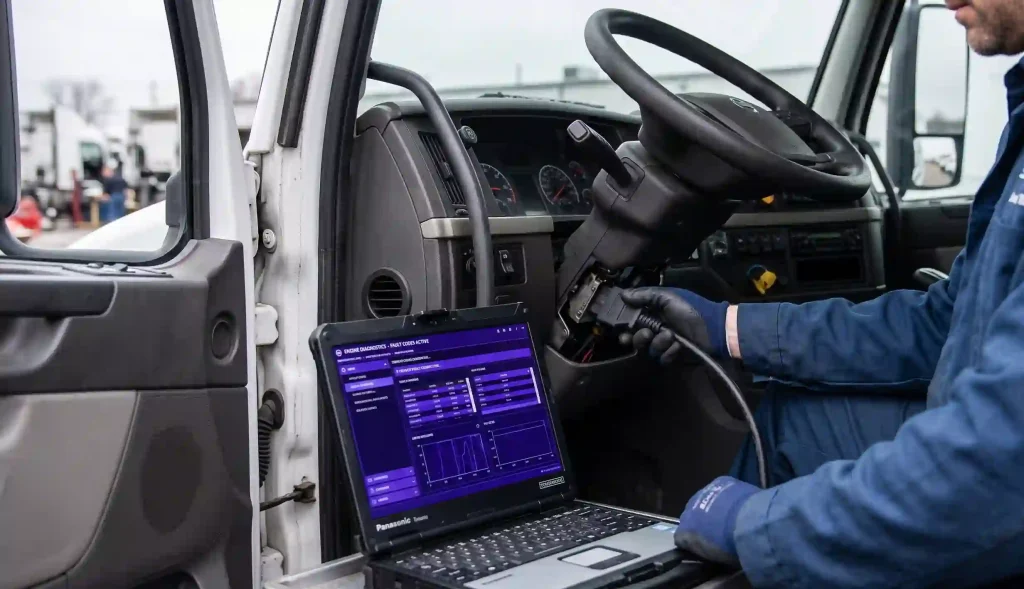
A Truck’s “Black Box” Is Actually Several Different Systems
“Black box” is a nickname, not one single device. On a modern commercial truck, several onboard computers each record a different slice of the same event, and lawyers often need all of them to build a full picture:
- Engine Control Module (ECM): The engine’s own computer. It tracks speed, RPM, throttle position, cruise control status, and hard-braking events as part of normal operation.
- Event Data Recorder (EDR): A crash-triggered snapshot, similar in concept to what’s in your car, capturing the seconds immediately before and after a collision.
- Electronic Logging Device (ELD): Federally required equipment that automatically tracks a driver’s hours behind the wheel.
- GPS and telematics: Location and route history that can confirm where the truck was and how fast it was moving over time.
Here’s a distinction worth understanding: NHTSA’s Event Data Recorder rule (49 CFR Part 563) only applies to passenger cars and light vehicles, and even then it’s a voluntary “if equipped” standard, not a mandate. There is no matching federal rule that spells out exactly what a heavy truck’s ECM has to record. What a specific tractor actually captured depends on the engine manufacturer and how the system was configured, which is one reason these cases usually need an expert who knows the specific make of engine involved.
Speed and Braking Data Can Contradict the Trucking Company’s Story
In most disputed truck crashes, the trucking company and its insurer have a version of events where the driver did nothing wrong. ECM data tests that story against physics and timestamps. If the driver claims they braked hard and swerved to avoid the crash, but the ECM shows no brake application and a steady throttle right up to impact, that gap is hard to explain away. If it shows the truck traveling well above the posted limit, that becomes objective proof rather than a dispute between witnesses.
This is where the data can turn into more than just evidence, it can become the legal theory itself. When ECM or ELD records show a driver broke a specific federal safety rule, like exceeding the allowed driving window, that violation can support a “negligence per se” argument. In plain terms, the regulatory violation itself is treated as evidence of negligence, rather than something a jury simply weighs alongside everything else.
Hours-of-Service Data Can Catch Fatigue a Driver’s Own Logbook Won’t Show
Federal rules cap how many hours a commercial driver can be behind the wheel before resting, and the ELD mandate under 49 CFR 395.8 requires most drivers to log those hours electronically rather than on paper. Paper logs could be adjusted after the fact. Electronic logs are harder to alter, but they aren’t foolproof, since a driver can still mark themselves “off duty” while the truck’s own engine data tells a different story.
That’s exactly the kind of mismatch attorneys look for: engine hours and movement on the ECM that don’t line up with what the driver’s ELD says they were doing. If the engine was running and the truck was moving while the log shows the driver resting, that discrepancy can point directly to fatigue, and to a federal hours-of-service violation the trucking company will have a hard time explaining.
Real Case: What Happens When a Trucking Company Doesn’t Preserve the Data
This is a real, reported case, not a hypothetical.
In Barry v. Big M Transportation, Inc., 2017 WL 3980549 (N.D. Ala. Sept. 11, 2017), a family injured when a Big M tractor-trailer struck three vehicles sent the trucking company a preservation letter asking it to keep the truck’s ECM data. Despite that, the company repaired the truck and sold it as part of a fleet swap without ever downloading the data. The court found that Big M’s own manager had testified it was normal company practice to pull ECM data after a serious crash, and that nothing had stopped them from doing it here. The court ruled that this failure amounted to spoliation, the legal term for destroying evidence a party had a duty to preserve, because litigation was clearly foreseeable.
The court didn’t hand down the harshest possible penalty, since it wasn’t convinced Big M had acted in bad faith. But it allowed the jury to hear that the data was never preserved and to weigh that failure when deciding the case. It’s a reminder of two things: this data can disappear through nothing more dramatic than routine maintenance, and courts are willing to hold trucking companies accountable when they had the chance to preserve it and didn’t.
Example Scenario (Illustrative Only)
The following is a fictional example used to illustrate how this typically plays out. It is not a real case.
Picture a driver merging onto a highway who’s struck from behind by a loaded box truck. The truck driver tells the responding officer that a car cut in front of him, forcing a sudden stop he couldn’t avoid. Within days, the injured driver’s attorney sends the trucking company a preservation letter demanding the ECM, ELD, and dispatch records be held and not touched. A retained technician, present alongside the carrier’s own expert, downloads the ECM’s crash snapshot. It shows no brake application in the seconds before impact and a speed several miles per hour above the posted limit. Cross-referencing the ELD shows the driver had been on duty for close to the legal limit that shift. None of that proves distraction on its own, but together it gives the injured driver’s side a factual foundation, rather than one person’s word against another’s, to negotiate from.
Canada Follows a Similar but Separate Set of Rules
Trucking accidents involving federally regulated carriers in Canada are governed by their own framework. Transport Canada’s electronic logging device mandate reached full enforcement on January 1, 2023, and it applies to federally regulated commercial drivers operating buses and trucks across provincial, territorial, or international lines. The Canadian rule was modeled closely on the US ELD rule, and covers similar ground: tamper-resistant recording of driving time, on-duty status, and engine power-up events.
Where things diverge is in the civil litigation process. Preservation obligations, spoliation consequences, and the deadlines for filing a claim are set by each province, not by one national personal injury law, so anyone hurt in a Canadian trucking accident should get advice specific to that province quickly rather than assuming US procedures apply.
There’s No Public Count of How Often This Data Decides a Case, and That’s Worth Saying Plainly
It would be useful to be able to cite a hard number, something like “ECM data resolves X% of truck accident claims in the US and Canada.” No government agency or court system publishes a statistic like that, and no reliable source claims to track it. What does exist is a growing body of published court decisions, in states from Alabama to Florida to Georgia, addressing what happens when this data is lost or withheld. That pattern shows courts increasingly treat ECM and ELD data as evidence serious enough to fight over, even without a national tally of outcomes.
What You Can Do to Protect This Evidence and Your Compensation
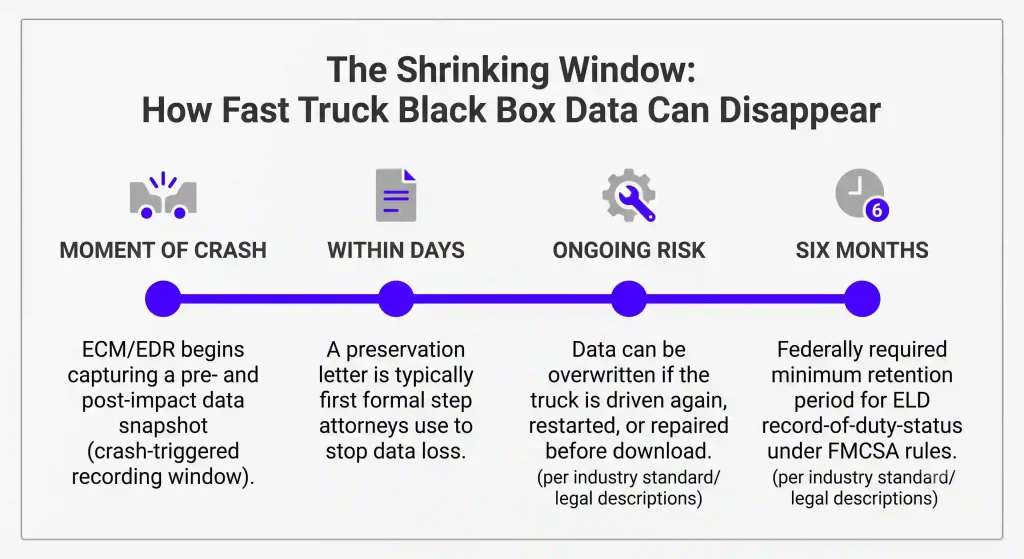
- Move fast. Some ECM systems record in a continuous loop, and data can be overwritten simply by the truck being driven or having its engine restarted after the crash.
- Send or request a preservation letter immediately. This puts the trucking company on formal notice not to repair, sell, or otherwise alter the truck until the data has been downloaded.
- Insist on a qualified download, not a summary. Because the data lives in a proprietary format, a trained technician using manufacturer-specific tools is usually needed, ideally with both sides’ experts present so admissibility isn’t contested later.
- Cross-reference every source. ECM speed and braking data, ELD hours, dispatch records, and maintenance logs can each confirm or contradict the others; a mismatch between any two is often where fatigue, speeding, or neglected maintenance shows up.
- Understand what this does, and doesn’t, guarantee. Verified data can meaningfully strengthen a negligence case and give you real leverage in settlement talks, but it doesn’t promise a specific outcome or dollar amount, and no honest attorney will tell you otherwise.
- Talk to an attorney early, even though the deadline to actually file a lawsuit is usually measured in years. The evidence that would prove your case can vanish in days.
This article is for general educational purposes only and is not legal or medical advice. Every truck accident case depends on its own facts and the laws of the state or province where it happened. If you've been injured in a truck accident, consider speaking with an attorney about your specific situation.
FAQs
What exactly does a truck’s ECM record?
It varies by engine manufacturer, but typically includes vehicle speed, RPM, throttle position, cruise control status, hard-braking events, and engine fault codes in the period around a crash.
Is ECM data the same as an EDR or an ELD?
No. The ECM is the engine’s ongoing operating computer, the EDR is a crash-triggered snapshot similar to a car’s airbag module, and the ELD is the federally required device that tracks a driver’s hours. They often overlap and can confirm one another.
How fast can ECM data disappear after a crash?
It depends on the system, but data can be overwritten if the truck is driven again, restarted, or repaired. That’s why a preservation letter is usually sent within days of a crash, not weeks.
Can a trucking company get in trouble for losing the ECM data?
Courts can impose penalties for spoliation, destroying evidence a party had a duty to preserve, ranging from allowing the jury to hear about the failure to more serious sanctions, depending on whether the destruction looks intentional.
Does ECM data alone prove who caused a crash?
Not by itself. It’s usually combined with ELD hours, dispatch and maintenance records, witness statements, and often an accident reconstruction expert to build a full picture.
Is the ECM rule the same in Canada as in the United States?
Canada’s federal ELD mandate, fully enforced since January 1, 2023, was modeled on the US rule and covers similar ground, but the civil litigation process around preserving and using that data is set by each province.
How soon should I contact an attorney after a truck accident?
As early as possible. The deadline to file a lawsuit is usually measured in years, but the evidence that proves your case can be lost within days if no one asks the trucking company to preserve it.
Research & Sources
- Barry v. Big M Transportation, Inc., 2017 WL 3980549 (N.D. Ala. Sept. 11, 2017): https://www.ediscoverylaw.com/wp-content/uploads/2021/12/Barry-v.-Big-M-Transportation-Case-Opinion.pdf
- National Law Review, “eDiscovery Includes Electronic Vehicle Data and Possible Sanctions for Spoliation”: https://natlawreview.com/article/ediscovery-includes-electronic-vehicle-data-and-possible-sanctions-spoliation
- Proskauer Rose LLP, same case analysis: https://www.proskauer.com/blog/ediscovery-includes-electronic-vehicle-data-and-possible-sanctions-for-spoliation
- NHTSA/US DOT, Event Data Recorders rulemaking (49 CFR Part 563): https://www.transportation.gov/regulations/federal-register-documents/2025-21506
- FMCSA, Electronic Logging Devices: https://www.fmcsa.dot.gov/hours-service/elds/electronic-logging-devices
- FMCSA, General Information About the ELD Rule (FAQ, six-month retention): https://www.fmcsa.dot.gov/hours-service/elds/general-information-about-eld-rule
- eCFR, 49 CFR Part 395 Subpart B: https://www.ecfr.gov/current/title-49/subtitle-B/chapter-III/subchapter-B/part-395/subpart-B
- Transport Canada: https://tc.canada.ca/en
- Collins Law Group, “Truck Black Box Data” (background on manufacturer-specific ECM variation): https://www.collinslaw.com/truck-black-box-data