




Imagine you are driving home from work along a busy suburban arterial road. The light ahead turns green, and you enter the intersection at 43 mph slightly above the 35 mph speed limit. Suddenly, a commercial delivery truck running a late red light T-bones your driver’s side door.
You wake up in the emergency room with severe orthopedic fractures, a traumatic brain injury (TBI), and a destroyed sedan. Your medical bills quickly mount to $180,000, and you are forced off work for six months, incurring $35,000 in lost wages. When your attorney files an insurance claim, the adjuster does not deny that their truck driver ran the red light. Instead, they point to your speed and assign you 51% of the blame.
Under the modified comparative fault 51 percent rule, that single assignment of 51% fault drops your legal compensation from $215,000+ directly to $0.
Understanding how modified comparative fault works and how insurance carriers manipulate fault percentages is the most critical factor in protecting your post-accident financial recovery
To see how your jurisdiction compares to pure comparative or contributory negligence systems, explore our comprehensive guide to state personal injury laws and tort reforms
What Is the Modified Comparative Fault 51 Percent Rule?
The modified comparative fault 51 percent rule (often called the “51% bar rule”) is a legal doctrine governing personal injury cases in roughly 23 states. As defined by the Cornell Law School Legal Information Institute (LII) , an injured person (the plaintiff) under this framework can recover financial compensation from another negligent party only if their share of responsibility for the accident is 50% or less.
If a judge, jury, or insurance adjuster determines that your portion of fault reaches 51% or higher, you are completely barred from recovering a single dollar in damages from the other party.
If your fault is found to be 50% or below, you remain eligible to collect compensation, but your total award is reduced proportionally by your percentage of blame.
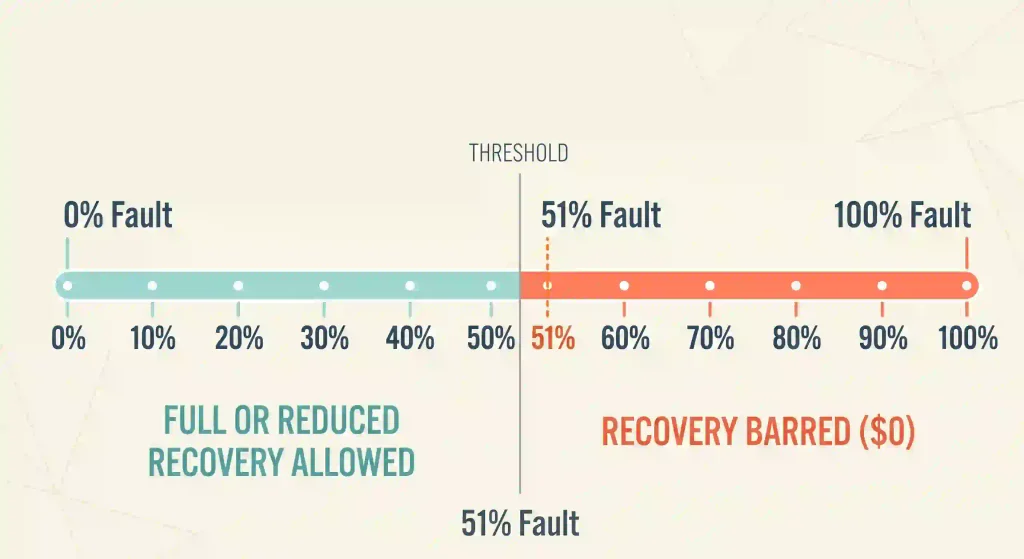
The Tipping Point: 50% vs. 51%
To understand why this rule is so fiercely litigated, compare it to the alternative systems used in other U.S. states:
- Pure Comparative Fault (e.g., California, Florida, New York): You can recover damages even if you are 99% at fault, though your recovery is reduced by 99%. For a detailed side-by-side of two major states on opposite ends of this rule, see our guide on pure comparative negligence in California vs. Florida.
- Modified Comparative Fault 50 Percent Rule (e.g., Colorado, Georgia): You can recover only if you are 49% or less at fault. At 50%, you get nothing.
- Modified Comparative Fault 51 Percent Rule (e.g., Texas, Illinois, Ohio): You can recover as long as you are not more than 50% at fault. The “bar” drops at 51%.
- Contributory Negligence (e.g., Virginia, Maryland, North Carolina): If you are even 1% at fault, you receive $0.
How the 51% Rule Math Works in Practice
To see how this impacts an real-world personal injury recovery, consider three distinct potential jury verdicts for a crash resulting in $200,000 total damages:
| Scenario | Plaintiff’s Assigned Fault | Calculation | Final Payout to Plaintiff |
| Scenario A | 10% At Fault (e.g., minor speeding) | $200,000 – (10% of $200,000) | $180,000 |
| Scenario B | 50% At Fault (Equal shared responsibility) | $200,000 – (50% of $200,000) | $100,000 |
| Scenario C | 51% At Fault (Slight majority share) | Recovery Barred by 51% Rule | $0 |
Notice the dramatic difference between Scenario B and Scenario C. A single percentage point difference in fault valuation results in a $100,000 loss for the victim.
Which States Follow the Modified Comparative Fault 51 Percent Rule?
State tort standards vary across jurisdictions. Below are key states that enforce a 51% threshold or equivalent “greater than 50%” bar rule, along with their official statutory references:
- Connecticut: Enforced under Conn. Gen. Stat. § 52-572h.
- Illinois: Governed by 735 ILCS 5/2-1116.
- Indiana: Codified under Ind. Code § 34-51-2-6.
- Massachusetts: Governed under Mass. Gen. Laws ch. 231 § 85.
- Michigan: Enforces a 51% bar specifically on non-economic damages per MCL 600.2959.
- New Jersey: Outlined in N.J.S.A. 2A:15-5.1.
- Ohio: Standardized via Ohio Rev. Code § 2315.33.
- Pennsylvania: Outlined under 42 Pa.C.S. § 7102.
- Texas: Known as “Proportionate Responsibility” codified under Tex. Civ. Prac. & Rem. Code § 33.001.
- Wisconsin: Established under Wis. Stat. § 895.045.
(Note: State legislatures update statutory frameworks periodically. Additional 51% rule states include DE, HI, IA, MN, MT, NV, NH, OK, OR, SC, VT, and WY).
The Human Experience: The Natural Journey of a 51% Rule Claim
When an unexpected injury occurs, the legal framework operating in the background heavily impacts every stage of your recovery journey.
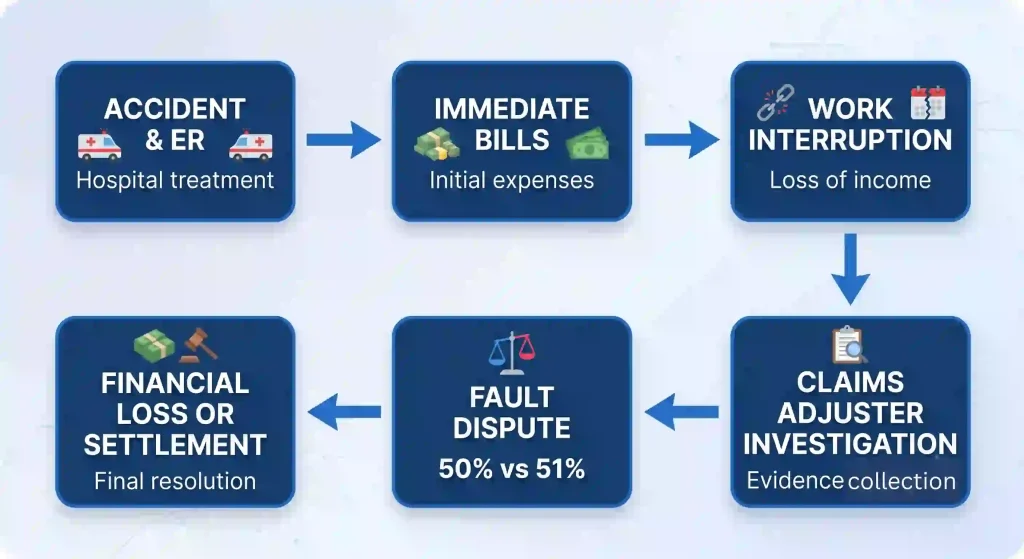
1. The Immediate Aftermath & Medical Crisis
In the hours following an injury, your primary focus is survival and medical stabilization. Emergency department visits, diagnostic CT scans, surgeries, and initial physical therapy generate bills rapidly.
2. Income Interruption & Growing Stress
As initial bills land in your mailbox, missing work amplifies the pressure. In 51% rule states, insurance adjusters exploit this financial strain. Knowing that a 51% fault rating eliminates their financial exposure entirely, adjusters often conduct initial interviews designed to coax statements indicating shared blame.
3. The “Comparative Fault” Trap During Adjuster Interviews
A casual comment like “I might have been moving a bit fast” or I didn't see him until the last second will be documented by insurance representatives. In a 51% rule state, these statements are routinely weaponized to push your comparative fault from 20% or 30% up to 51%.
How Insurance Carriers Weaponize the 51% Threshold
Insurance defense strategies in 51% bar states differ significantly from pure comparative states. Because total defense victory requires proving only 51% plaintiff fault, adjusters use specific tactics:
- Delaying Claims Processing: Pushing negotiations near statutory deadlines forces injured victims to evaluate whether to risk total loss at trial or settle for a lower amount.
- Blaming Pre-Existing Conditions: Claiming that a back injury or shoulder tear was partly pre-existing to assign fractional fault to the victim’s health history.
- Exploiting Traffic Infractions: Using minor technical violations—such as an expired registration, failing to signal 100 feet prior, or driving 3 mph over the speed limit to shift majority liability.
Hypothetical Case Scenario: The Disputed Left Turn
Case Example: Sarah was making a left turn at a yellow light in Houston, Texas. Mark was oncoming, traveling 15 mph over the posted speed limit. Mark’s vehicle struck Sarah’s passenger side.
- The Defense Claim: The insurer argued Sarah committed a failure-to-yield violation, assigning her 60% fault (offering $0).
- The Investigation: Sarah’s legal team retrieved Mark’s vehicle Telematics/EDR (Black Box) data showing excessive speed and cellphone records proving active texting.
- The Outcome: The jury re-allocated liability to 80% Mark / 20% Sarah. Total proven damages of $300,000 resulted in a net payout of $240,000 to Sarah. Had her fault stayed at the insurer’s initial 60% valuation, she would have received $0.
Tactical Evidence Needed to Fight a 51% Fault Assignment
Overcoming unfair liability allocations requires objective, physical evidence gathered quickly after the incident:

- Event Data Recorders (EDR): Event Data Recorders (EDR): Vehicle “black box” data measuring exact speeds, steering input, and braking applications milliseconds before impact (governed under 49 CFR Part 563 regulations).
- Surveillance & Dashcam Footage: Video capturing light sequences, pedestrian movement, and lane positioning.
- Accident Reconstruction Analysis: Certified engineering models demonstrating angles of impact, momentum transfer, and visibility constraints.
- Cellular Records: Subpoenaed mobile carrier logs proving driver distraction.
Frequently Asked Questions (FAQs)
What happens if two parties are found equally at fault (50/50) in a 51% state?
Under the modified comparative fault 51 percent rule, if you are found exactly 50% at fault, you can still recover compensation. Your payout will simply be reduced by 50%. (Note: This differs from 50% bar states like Colorado, where 50% fault bars recovery).
Does the 51% rule apply to multi-car pileups or multi-party lawsuits?
Yes. In cases involving multiple defendants, your personal fault percentage is evaluated against the combined negligence of all other responsible parties in most 51% jurisdictions. As long as your individual responsibility does not hit 51%, you can seek recovery.
Can I still recover damages if I was not wearing a seatbelt?
In many states, failing to wear a seatbelt can be introduced as evidence of comparative negligence or failure to mitigate damages. While it rarely makes you 100% responsible for the crash itself, an insurer may argue it contributed 20%–40% to the severity of your injuries.
How do insurance adjusters calculate my percentage of fault during settlement negotiations?
Insurance adjusters do not use a fixed mathematical formula. They evaluate police reports, state traffic statutes, witness statements, and internal claim guidelines. Their initial percentage assignment is an opening negotiation position, not an absolute legal determination.
What is the difference between pure comparative fault and modified comparative fault?
Pure comparative fault allows a plaintiff to recover damages regardless of their degree of fault (even at 99% fault, they can recover 1%). Modified comparative fault introduces a threshold cap (either 50% or 51%). Reaching or exceeding that cap completely terminates the right to financial recovery.