

If you’ve been offered a $25,000 personal injury settlement, it’s natural to feel a sense of relief. You might already be mentally budgeting that money for your recovery. However, in the U.S. legal system, the “gross settlement” (the $25,000) is rarely the amount that ends up in your bank account.
Understanding how a settlement is divided is the best way to avoid “payout shock” at the end of your case. Our guide breaks down the math, the hidden costs, and the expert strategies used to keep more of your money.

The Quick Answer: What is Your "Take-Home" Pay?
In a typical U.S. personal injury case, a victim can expect to receive between $8,000 and $12,000 from a $25,000 settlement.
While this means you are “keeping” about 32% to 48% of the total, it’s important to remember that the rest of the money didn’t just disappear, it was used to pay off the debts incurred by the accident itself (like your lawyer’s work and your hospital visits).
Why You Don’t Get the Full $25,000
A personal injury settlement is designed to make you “whole” again. Because the accident created immediate costs, legal expertise to fight the insurance company and medical care to heal your body, those entities are legally entitled to be paid first.
1. Attorney Fees: The 33% Standard
Most personal injury lawyers work on a contingency fee basis. They take all the risk; if they don’t win, you don’t pay. In exchange, they take a percentage of the final settlement.
- Pre-Lawsuit: Usually 33.3% ($8,333).
- During Litigation: If your lawyer has to file a formal lawsuit in court, the fee often increases to 40% ($10,000) due to the significantly higher workload.
2. Case Costs (Out-of-Pocket Expenses)
Separate from the lawyer’s fee are the “costs” of doing business. Your lawyer usually pays these upfront and deducts them at the end.
- Police Reports: $25–$50
- Medical Record Retrieval: $100–$500
- Expert Reviews: If a specialist needs to review your MRI to prove the injury, this can cost $500–$1,500.
3. Medical Liens: The "Hidden" Deduction
This is where most people get confused. If your health insurance (like BlueCross or Aetna) or a government program (like Medicare) paid your bills, they have a legal right of subrogation. This means they must be paid back from your settlement.
- Consensual Liens: Agreements you signed with a doctor to “treat now, pay later.”
- Statutory Liens: Mandatory repayments to Medicare, Medicaid, or Workers’ Comp.
Realistic Example: The "Net Distribution"
Here is a sample breakdown of how a $25,000 settlement for a moderate whiplash or soft-tissue injury might look in 2026:
Realistic Example: The "Net Distribution"
| Category | Amount | Explanation |
| Gross Settlement | $25,000 | Total amount paid by the insurance company. |
| Attorney Fee (33.3%) | –$8,333 | Payment for legal representation. |
| Legal Case Costs | –$600 | Costs for records and filing fees. |
| Negotiated Medical Liens | –$7,000 | Hospital and physical therapy bills. |
| Final Net Payout | $9,067 | The actual check you receive. |
Is a Personal Injury Settlement Taxable?
One of the most common questions for U.S. readers is: “Does the IRS take a cut?”
Under IRS Publication 525, the answer is generally No. Compensation for physical injuries or physical sickness is non-taxable. This includes:
- Your payout for pain and suffering.
- Reimbursement for medical bills.
- Lost wages (if they resulted directly from the physical injury).
The Exception: If you receive “Punitive Damages” (money meant to punish the other driver for extreme recklessness) or “Interest” on the settlement, those specific portions are taxable as “Other Income.”
Expert Strategy: How to Increase Your Payout
You might not be able to change the lawyer’s fee, but you can increase your take-home pay through Lien Negotiation.
Many people don’t realize that hospital bills are not “set in stone.” A skilled attorney or negotiator will contact your medical providers after the settlement is reached to ask for a reduction.
- Example: If you owe a hospital $8,000, a lawyer may negotiate that down to $5,000.
- The Result: That $3,000 savings goes directly into your pocket, not the lawyer’s
Factors That Could Lower Your Check
1. Comparative Negligence (Shared Fault)
In states like California or Florida, if you are found 20% at fault for the accident, your $25,000 settlement is “pre-reduced.” If the total value of your damages was $31,250, your 20% fault brings it down to $25,000 before a single lawyer fee is even deducted.
2. Insurance Policy Limits (The “Hard Ceiling”)
If the person who hit you carries a “minimum policy” (which is exactly $25,000 in many states), that is the maximum the insurance company is legally required to pay. Even if your surgery costs $50,000, you cannot get more than the $25,000 limit from that insurer.
3. Gaps in Medical Treatment
Insurance adjusters look for any “gap” in your medical history to argue your injuries weren’t serious. If you waited 10 days after the crash to see a doctor, or if you skipped physical therapy for three weeks, the adjuster will likely slash the “Pain and Suffering” portion of your $25,000 offer.
4. Pre-Existing Conditions & Apportionment
If you had a back injury years ago and hurt your back again in this accident, the insurance company will try to “apportion” the damage. They may argue that 50% of your pain is “old news” and refuse to pay for it, significantly lowering your final payout.
5. Failure to “Mitigate Damages”
Under U.S. law, you have a duty to minimize your losses. If a doctor recommends a surgery that would heal you in two months, but you refuse it and remain in pain for a year, the insurance company can argue they aren’t responsible for the extra 10 months of suffering you “chose” to endure.
6. Health Insurance Subrogation (The “Right to Reimbursement”)
If your private health insurance (like Aetna or Kaiser) paid your $10,000 hospital bill, they have a legal right to be paid back from your settlement. This means $10,000 of your $25,000 check might go straight to your insurance company instead of your pocket.
7. Social Media & Surveillance
Insurance adjusters routinely monitor a claimant’s Facebook, Instagram, and TikTok. If you claim you have “loss of enjoyment of life” but post a photo of yourself at a wedding or the gym, they will use that evidence to argue your injury is a “fraud” and offer a much lower settlement.
8. Settling Before “MMI” (Maximum Medical Improvement)
If you settle your case while you are still in pain or still going to the doctor, you are taking a massive risk. Once you sign the release for $25,000, the case is closed forever. If you discover a month later that you need a $20,000 surgery, you cannot ask for more money.
When a settlement check is issued, it typically follows a specific order of operations before reaching your bank account. To help you visualize this, we have created this settlement distribution guide and a final checklist to maximize your final payout:
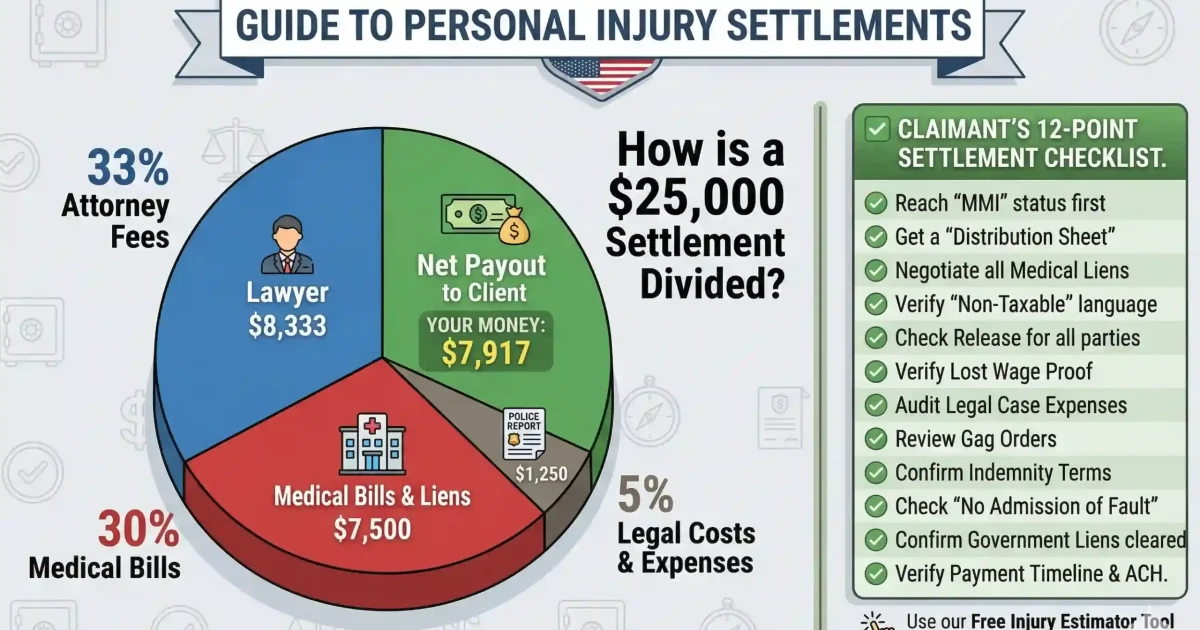
Summary Checklist for Claimants
1. Confirm "MMI" Status
Never settle while still in active treatment. Wait for Maximum Medical Improvement to ensure all future medical needs are covered.
2. Request a Distribution Sheet
Before signing, get a line-by-line breakdown. Know your exact "net" take-home amount after every fee and cost is deducted.
3. Audit Lien Reductions
Ask your lawyer for proof of negotiated medical bills. Every dollar saved on a hospital lien is an extra dollar in your pocket.
4. Verify Tax-Free Language
Ensure the release specifies funds are for "physical personal injuries" to keep the payout non-taxable under IRS Publication 525.
5.Check the Release Scope
Confirm the "Release of All Claims" only applies to the at-fault driver, don't accidentally waive your right to sue other responsible parties.
6. Verify Lost Wage Proof
Ensure your employer’s "Lost Wage Verification" letter is in the file so you are reimbursed for every hour of missed work and benefit.
7. Freeze Social Media
Do not post about your "win" or your recovery until the check has cleared. Insurers can pull offers if they see contradictory evidence online.
8. Final Timeline Check
Confirm how the money is being sent (Check vs. ACH) and the expected clearance date, typically 2 to 6 weeks post-signing.
9. Review Confidentiality Clauses
Check if the release has a "Gag Order." Some settlements forbid you from discussing the amount or the incident, even with friends.
10. Confirm "Indemnity" Terms
Make sure you aren't personally liable if a third party (like a health insurer you forgot to mention) comes looking for money later.
11. Check for "No Admission of Fault"
Most settlements state the defendant isn't "guilty," just paying to end the case. Ensure this doesn't hurt any secondary claims you have.
12. Double-Check Medicare/Medicaid
If you have government insurance, ensure the "Final Demand" letter from the CMS has been received so your payout isn't frozen by a federal hold.
Estimate Your Settlement Today
Disclaimer: This article is for informational purposes only and does not constitute legal or tax advice. Laws vary by state; please consult with a licensed professional in your jurisdiction
