




If the at-fault driver’s insurance limit is smaller than your medical bills, their insurer will only pay up to that limit, no matter how high your bills climb. The rest doesn’t just disappear. You may still be able to recover it through your own uninsured/underinsured motorist coverage, health insurance, MedPay, or in rare cases from the at-fault driver’s personal assets.
That’s the short version. Here’s what it actually looks like when it happens to you.
What Happens When Medical Bills Exceed Policy Limits: The Basics

A broken femur doesn’t check anyone’s coverage limits before it needs surgery, physical therapy, and months of follow-up visits. Insurance companies do check, though, and they will not pay a dollar more than the policy allows.
Every liability policy has a ceiling. In most states it’s written as three numbers, something like 25/50/25. The first number is the most the insurer pays for one person’s injuries. The second is the most it pays for everyone injured in the crash combined. The third covers property damage. Once your medical bills, lost wages, and pain and suffering add up past that first number, the insurance company’s checkbook closes. It doesn’t matter if the driver was clearly at fault or if a jury would later award you three times that amount. The policy is a contract, and the insurer only owes what the contract says.
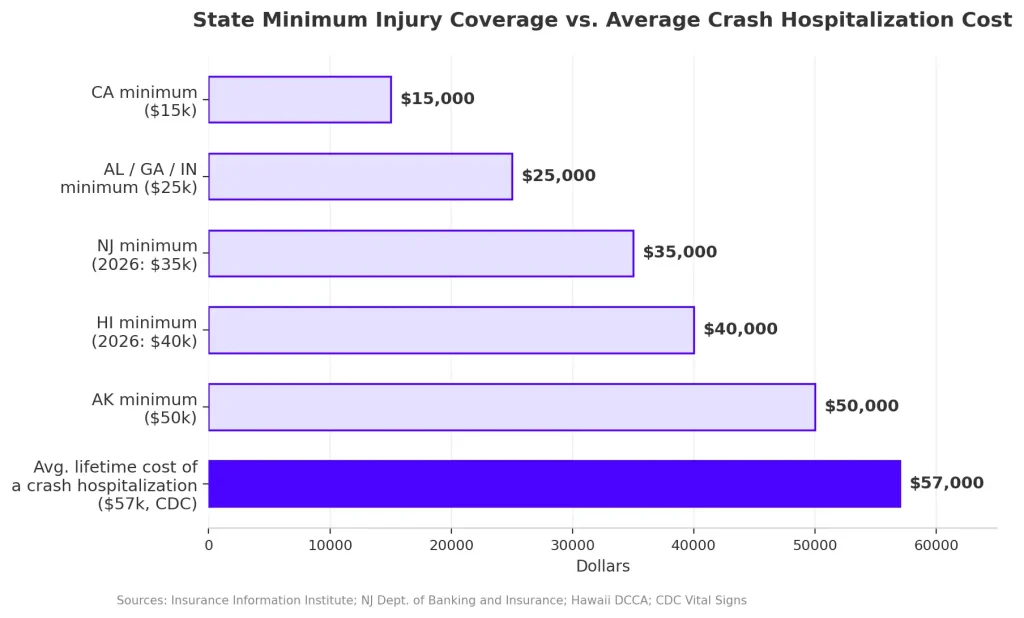
According to the Centers for Disease Control and Prevention, the average hospitalization from a crash injury costs about $57,000 over a person’s lifetime, and that’s before you add lost income or ongoing care. Compare that to a state minimum bodily injury limit of $25,000 per person, which is still the law in places like Alabama, Georgia, and Indiana, and you can see the gap forms fast. One serious hospital stay can blow past what many drivers are legally required to carry.
Why State Minimum Insurance Rarely Covers Serious Injuries
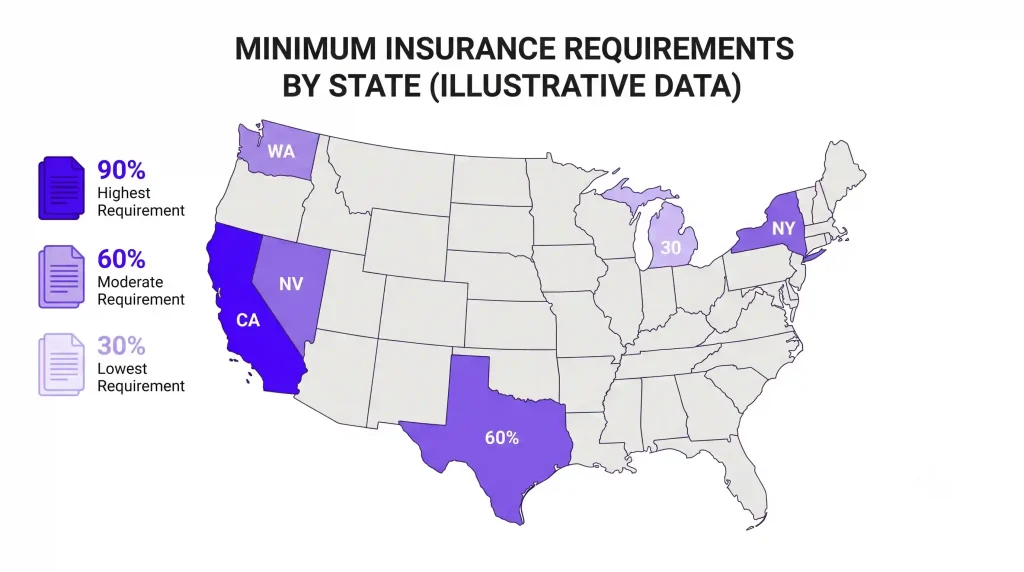
It’s tempting to assume the other driver has “enough” insurance. A lot of them don’t. State minimum limits were set years ago and haven’t kept up with today’s medical costs. The Insurance Information Institute’s state-by-state table shows several states still requiring as little as $15,000 to $25,000 per person in bodily injury coverage.
States are starting to notice. New Jersey’s Department of Banking and Insurance raised its minimum per-person limit to $35,000 starting January 1, 2026, up from $25,000, specifically because lawmakers recognized the old number wasn’t keeping pace with real accident costs. Hawaii did something similar. Its Division of Consumer Advocacy raised the state’s minimum bodily injury limit to $40,000 per person, also effective January 1, 2026, after the old $20,000 minimum had gone unchanged for years.
Not every state has caught up yet, and even a higher minimum can still fall short of a serious injury. In Nevada, state officials estimated that roughly a third of the state’s drivers were still carrying only the legal minimum before that state’s own limits went up. If you’re hit by someone in that position, the size of their wallet, not the size of your injury, ends up setting the ceiling on what their insurance will pay.
Infographic by EstimateMyInjury.com
Tap Your Own UM/UIM Policy to Fill the Gap
This is the part a lot of people don’t realize until they need it. If you carry uninsured/underinsured motorist (UM/UIM) coverage, your own insurance company can pay the difference between the at-fault driver’s policy limit and what your claim is actually worth, up to your own UM/UIM limit.
Say the at-fault driver has a $25,000 policy and your damages come to $70,000. If you have $50,000 in UIM coverage, you can typically pursue your own insurer for up to that additional $50,000 once the at-fault driver’s limit is exhausted. Some states require insurers to offer this coverage, and a few require you to carry it. Where it’s optional, it’s usually inexpensive relative to what it protects.
Health insurance and MedPay (medical payments coverage on your auto policy, if you have it) work differently. They pay your medical providers directly and don’t depend on who was at fault, though your health insurer may later place a lien on your settlement to recover what it paid. Check your own policy documents, or your declarations page, to see what coverage you’re actually carrying before you assume you’re stuck.
How Shared Fault Lowers Your Total Compensation
If you were partly at fault for the crash, that percentage typically reduces every dollar you can recover, including from UM/UIM coverage. How much it reduces it depends heavily on your state’s fault rules, and those rules vary more than most people expect. Some states cut your recovery off entirely if you’re found more than 50 percent at fault, while pure comparative negligence states let you recover something even if you were mostly to blame, just reduced by your share.
That distinction matters a lot when policy limits are already tight. A driver in a state with harsher fault rules may collect nothing extra even with UIM coverage in place, while someone in a pure comparative negligence state can still recover a reduced amount. It’s worth understanding which category your state falls into before you count on any particular number.
Case Breakdown: Handling a $36,000 Coverage Deficit
This is a fictional example to illustrate how the numbers can play out, not a real case.
Picture Maria, rear-ended by a driver carrying the bare state minimum of $25,000 per person. Her hospital stay, physical therapy, and four weeks of missed work add up to $61,000. The at-fault driver’s insurer sends the full $25,000 policy limit almost immediately, since it’s clear liability isn’t in dispute and the insurer wants to close the file cheaply. That leaves a $36,000 gap.
Maria checks her own auto policy and finds she carries $50,000 in UIM coverage. She files a UIM claim with her own insurer for the difference. Her insurer investigates, confirms the at-fault driver’s limit was exhausted, and negotiates a UIM settlement covering most of the remaining gap. Without that coverage, Maria would have been left absorbing tens of thousands of dollars in bills herself, or pursuing the at-fault driver personally, which is often a dead end if that driver has few assets.
Real Case: Forcing Insurers Beyond Policy Limits
Sometimes the story isn’t about the injured person’s coverage at all, it’s about what happens to the at-fault driver’s own insurer when it refuses to pay within the policy limit while it still can.
The foundational case here is G.A. Stowers Furniture Co. v. American Indemnity Co., decided by the Texas Supreme Court in 1929. An injured woman offered to settle her claim for $4,000, which was within the at-fault company’s $5,000 policy limit. The insurer refused and offered only $2,500. The case went to trial, and the jury awarded more than $14,000, nearly three times the policy limit. Texas courts held that the insurer had a duty to act as a reasonably prudent insurer would when deciding whether to accept a settlement offer within the policy limit, and that failing to do so could make the insurer liable for the entire excess judgment, not just the original policy amount.
Nearly a century later, courts across the country still cite this case (often called the “Stowers doctrine” in Texas and similar names elsewhere) when an insurer sits on a reasonable, within-limits settlement offer and gambles on trial instead. It’s a reminder that policy limits aren’t always the hard ceiling they first appear to be, especially for the insurer that ignored a chance to settle within them.
4 Critical Steps to Take When Bills Surpass the Cap
If you’re in this situation right now, a few steps make a real difference. Get a copy of the at-fault driver’s declarations page early, so you know the actual limit you’re dealing with rather than guessing. Pull your own auto policy and check for UM/UIM coverage and its limit. Keep every medical bill and record, since a strong, well-documented claim gives your own insurer less room to argue about value in a UIM negotiation. And if the numbers are large or your state’s fault rules are working against you, talk with a personal injury attorney before accepting any settlement, since once you sign a release, you generally can’t come back for more later, even if your bills keep growing.
None of this changes overnight, and every insurer moves at its own pace. But knowing where the real money can come from, your own coverage, MedPay, health insurance, or in rare cases the driver’s own assets, puts you in a much stronger position than assuming the policy limit is the end of the story.
Frequently Asked Questions
1. Can I sue the at-fault driver personally for the amount their insurance didn’t cover?
You can, but collecting is often difficult if the driver doesn’t have significant personal assets. Courts don’t create money out of thin air; a judgment against someone with no savings, property, or wages to garnish is often not worth much in practice.
2. Does my own insurance rate go up if I file a UM/UIM claim?
In most states, insurers can’t raise your rate for a claim that wasn’t your fault, including a UM/UIM claim against your own policy. Rules vary by state and insurer, so it’s worth asking your agent directly.
3. What if the at-fault driver has no insurance at all?
This is exactly what uninsured motorist (UM) coverage is designed for, as opposed to underinsured motorist (UIM) coverage, which applies when the other driver has some insurance but not enough. If you don’t carry UM coverage, your options narrow significantly.
4. Is MedPay the same thing as UM/UIM coverage?
No. MedPay (or Personal Injury Protection in some states) pays your medical bills up front regardless of fault, but it’s usually a much smaller amount, often $1,000 to $10,000. UM/UIM coverage is meant to replace the liability coverage the at-fault driver should have had.
5. Can I stack my UIM coverage with the at-fault driver’s policy?
Some states allow “stacking,” where you can combine coverage from multiple vehicles on your policy, or in limited cases combine your UIM limit with the at-fault driver’s limit for a larger total. Whether stacking is allowed depends entirely on your state and your specific policy language.
6. How long do I have to file a UM/UIM claim after an accident?
This is usually governed by your policy’s contractual deadlines, which can be shorter than your state’s general injury statute of limitations. Check your policy or ask your insurer directly, since missing this window can end your claim before it starts.
7. Will my health insurance company want its money back from my settlement?
Often, yes. Many health insurers have a right of reimbursement (a lien) for medical costs they paid, which they’ll expect to recover once you settle with the at-fault driver’s insurer or your own UIM carrier.
Research & Sources
- CDC Vital Signs, “Motor Vehicle Crash Injuries” (2014 report on 2012 data): https://www.cdc.gov/vitalsigns/pdf/2014-10-vitalsigns.pdf
- Insurance Information Institute, State Minimum Liability Limits Table: https://www.iii.org/table-archive/21211
- New Jersey Department of Banking and Insurance, Bulletin No. 25-06: https://www.nj.gov/dobi/bulletins/blt25_06.pdf
- Hawaii Division of Consumer Advocacy, Auto Insurance Minimum Limits FAQ: https://cca.hawaii.gov/ins/files/2023/05/Auto-Minimum-Limits-FAQs.pdf
- Nevada DMV, “Insurance Minimums Up July 1”: https://dmv.nv.gov/news/18004-insurance-minimums-up-July1.htm
- Texas Supreme Court opinion discussing G.A. Stowers Furniture Co. v. American Indemnity Co., 15 S.W.2d 544 (Tex. Comm’n App. 1929): https://www.txcourts.gov/media/1452128/190701.pdf
