




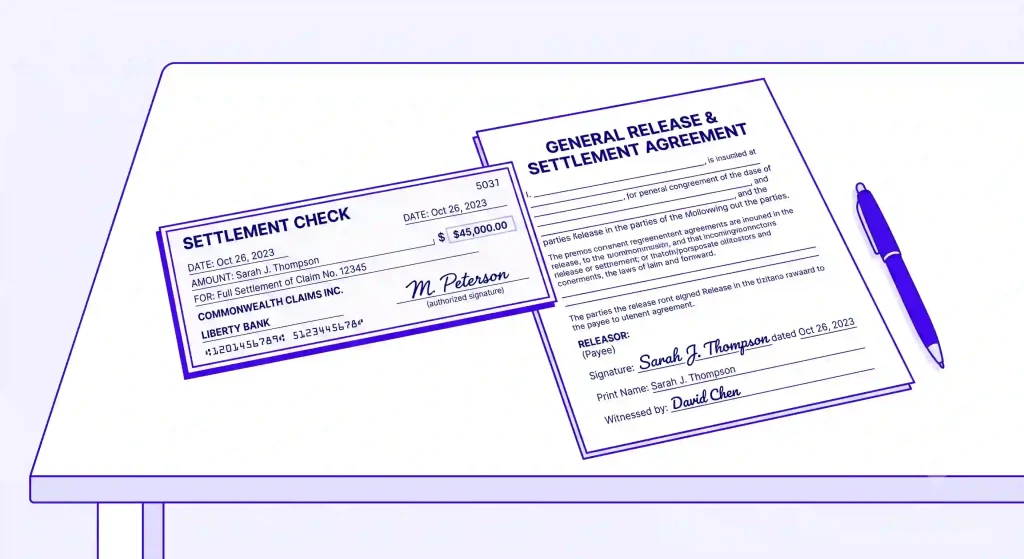
Yes, in most cases you can keep your personal injury settlement money without ever setting foot in a courtroom. The vast majority of injury claims are resolved directly with the insurance company before a lawsuit is ever filed, and once you sign a release and cash the check, the money is yours to use. The real limits on what you get to keep usually come from attorney fees, unpaid medical bills, health insurer reimbursement clauses, or liens filed by Medicaid or Medicare, not from any requirement to go to trial.
Government data backs this up. Court statistics compiled by the U.S. Department of Justice found that only about 4 percent of tort claims that reach a national sample of state courts are ever resolved by a bench or jury trial, and that figure only counts cases where a lawsuit had already been filed. Most injury claims never make it that far, because insurers would rather negotiate a settlement than risk a jury verdict.
That said, “keeping” a settlement is not automatic just because you avoided court. Before the check clears, there is usually a list of people with a legal claim to part of it, your attorney, a health insurer, a hospital, a workers’ compensation carrier, or a government program. Understanding who gets paid first, and in what order, is the real difference between a settlement number on paper and the amount that actually lands in your bank account.
Why Most Injury Claims Never Reach a Courtroom
After a car accident, slip and fall, or workplace injury, most people deal directly with an insurance adjuster rather than a courtroom. Adjusters are trained to resolve claims quickly because litigation is expensive and unpredictable for the insurance company too. If liability is reasonably clear and the medical treatment is well documented, an insurer often extends a settlement offer within weeks or months of the injury, long before anyone files a complaint in court.
This pre-suit stage is where most settlements happen. You submit medical records, wage-loss documentation, and a demand letter. The adjuster responds with an offer, negotiation follows, and if you agree on a number, you sign a release in exchange for payment. No judge, no jury, no courtroom. For how a demand and negotiation process typically plays out, the general settlement process pillar walks through each stage in more detail.
Signing a Release: What Rights You Give Up
The document you sign to accept a settlement is called a release, and it matters more than the check itself. A release is a binding contract in which you give up your right to sue the at-fault party over that specific incident, in exchange for the settlement amount. Once it’s signed and the payment clears, you generally cannot go back and ask for more money later, even if your injury turns out to be worse than expected.
This is why rushing to accept the first offer can backfire. If you sign before you’ve finished treatment or before you know the full cost of your medical care, you may be locking in a number that doesn’t cover everything you’ll actually owe. Reading the release carefully, and understanding exactly what claims it resolves, is one of the most important steps between “settlement offered” and “settlement money in hand.”
Attorney Contingency Fees and Out-of-Pocket Expenses
If you hired a personal injury lawyer, their fee is almost always the single biggest deduction from a settlement, and it’s worth understanding before you assume a settlement figure is what you’ll actually pocket. Most personal injury lawyers work on a contingency fee, meaning they only get paid if you recover money, and their payment is a percentage of that recovery rather than an hourly rate. According to Cornell Law School’s Legal Information Institute, contingency fees in personal injury cases are commonly around one-third of the recovery, though agreements can range higher or lower depending on the case and when it resolves.
On top of the percentage fee, case expenses like medical record requests, expert consultations, or filing fees are usually deducted separately, either by the attorney upfront or out of the final settlement. A written fee agreement should spell out exactly how the percentage is calculated and whether it applies before or after those expenses come out, so reading that agreement closely before signing is worth the time. If you haven’t hired an attorney yet and are still deciding, how to find a good personal injury lawyer covers what to look for in a fee arrangement and a track record.
Claims settled directly with an adjuster before ever hiring an attorney skip this deduction entirely, which is one reason some people choose to negotiate smaller, clear-liability claims on their own. The tradeoff is that an experienced negotiator can sometimes recover enough more than you would on your own to offset the fee, so this is a genuinely case-by-case decision rather than a one-size-fits-all rule.
Liens and Reimbursements That Reduce Your Payout
This is where most of the remaining confusion around “keeping” settlement money comes from. Even when a case never goes near a courtroom, several parties may have a legal right to be paid out of the settlement before you take the rest home.
Health insurance subrogation. Many health plans include a subrogation clause, meaning if your insurer paid your medical bills after the accident, it can require reimbursement once you recover money from the at-fault party. This is standard in most employer health plans and is enforceable under the plan’s own contract terms.
Hospital and medical provider liens. In many states, hospitals and treating providers can file a lien directly against a settlement to secure payment for care they provided, especially when a patient was treated without insurance or on a promise to pay from the eventual settlement.
Medicaid liens. State Medicaid programs are required by federal law to seek reimbursement when a recipient’s medical bills were caused by someone else’s negligence and later recovered through a settlement.
Medicare liens. If you’re a Medicare beneficiary, the Medicare Secondary Payer program requires that Medicare be reimbursed for any conditional payments it made related to the injury once a liability settlement resolves the claim, regardless of whether a lawsuit was ever filed.
None of these liens require you to go to court. They attach automatically, or by contract, and are typically resolved by negotiation with the lienholder before the settlement funds are fully distributed to you. It’s also common for attorneys to negotiate a lienholder down once the cost of obtaining the recovery, including their own fee, is factored in, since a lienholder collecting from a smaller net recovery has an incentive to compromise rather than risk collecting nothing.
Case Study: How Federal Law Limits Government Liens
A useful example of how far these liens can reach, and where the law draws the line, comes from the U.S. Supreme Court’s decision in Arkansas Department of Health and Human Services v. Ahlborn. Heidi Ahlborn was permanently disabled in a car accident and received Medicaid benefits covering roughly $215,000 in medical costs. She later settled her injury claim for $550,000, a figure that was never allocated between medical expenses and other damages like pain and suffering or lost future earnings.
Arkansas’s Medicaid agency tried to claim the full $215,000 out of that settlement. The Supreme Court disagreed, ruling unanimously that federal Medicaid law only allows a state to recover the portion of a settlement that represents payment for past medical expenses, not compensation meant for pain, suffering, or lost income. Because the parties had stipulated that medical costs made up roughly one-sixth of the case’s full value, Medicaid’s actual recovery was limited to about $35,000 instead of the full lien amount.
The practical lesson: a lien doesn’t automatically consume your entire settlement, and the way a settlement is documented and allocated can directly affect how much a lienholder is entitled to collect. This is exactly the kind of detail worth discussing with whoever is helping you resolve your claim before you sign anything.
Accounting for Lost Wages and Future Medical Care
Before you think about what you’ll do with a settlement check, it helps to look backward at what the money is actually meant to cover. Lost wages from missed work, ongoing physical therapy, prescriptions, and any anticipated future treatment are usually baked into the settlement figure. If those costs weren’t accounted for during negotiation, the money that’s technically “yours to keep” may not stretch as far as it needs to.
This is one area where documentation matters enormously. A pay stub showing missed shifts, a doctor’s note estimating future treatment, or a letter outlining long-term care needs all strengthen a demand and reduce the odds that you’ll be left covering out-of-pocket costs after the settlement is spent.
Taxes: Is Personal Injury Settlement Money Taxable?
Whether you owe anything to the IRS is a separate question from whether liens or fees reduce your payout, and it depends heavily on what the settlement is compensating you for. Compensation for physical injuries is generally not taxable, but portions allocated to lost wages or punitive damages can be treated differently. This is a big enough topic on its own that it’s covered in full in the site’s guide to whether personal injury settlements are taxable, which walks through the IRS rules in detail.
Protecting Your Settlement from Creditors and Debt Collectors
Getting past liens, fees, and taxes doesn’t necessarily mean the settlement is fully insulated once it hits your bank account. If you owe unpaid federal back taxes, the IRS can, in some circumstances, pursue funds you’ve already deposited, which is one reason many people keep settlement money in a separate account rather than mixing it with everyday income. Depositing settlement funds into an account you also use for regular bills can make it harder to show which dollars came from the settlement if a creditor ever disputes the funds.
State exemption laws vary on how much protection a personal injury settlement gets from general creditors and debt collectors once it’s been received, so this isn’t a single nationwide rule. If you have outstanding debts, judgments, or a support obligation, it’s worth understanding your state’s exemption rules, or speaking with an attorney, before assuming the full settlement is untouchable simply because your case never went to court.
When Filing a Lawsuit Becomes Necessary
Not every claim stays out of court. If an insurer disputes liability, undervalues the claim, or simply stops responding to a demand, filing a lawsuit can become the only way to move the case forward. Even then, most lawsuits still settle before trial. Filing a complaint often restarts negotiations with more urgency, since litigation exposes the insurer to legal costs and the uncertainty of a jury outcome.
If you’re unsure whether your claim is heading toward a fast settlement or a drawn-out dispute, understanding your state’s filing deadline matters early on. The statute of limitations for personal injury claims varies significantly by state, and missing it can eliminate your ability to sue even if negotiations stall.
Pre-Settlement Checklist: 5 Things to Verify Before Cashing Out
Before signing a release or depositing a settlement check, it’s worth confirming a few things: how the attorney fee and case costs are calculated, whether your health insurer or Medicaid/Medicare has a reimbursement claim, whether any medical providers have filed liens, whether the settlement accounts for future treatment, and whether the release language is limited to this incident rather than broader claims. None of this requires a lawsuit, but skipping this step is how people end up surprised by deductions they didn’t expect.
For a general sense of how a settlement figure gets built from these different pieces, the State Laws guide covers how state-specific rules can affect timelines, comparative fault, and lien priority.
This article is for general education only and is not legal or medical advice. Every state’s lien laws, creditor exemption rules, insurance contracts, and Medicaid/Medicare rules differ, so speak with a licensed attorney or your lienholder directly before signing a release or spending settlement funds.
Research & Sources
- U.S. Department of Justice, Bureau of Justice Statistics, “Tort Bench and Jury Trials in State Courts, 2005” — https://bjs.ojp.gov/redirect-legacy/content/pub/pdf/tbjtsc05.pdf
- Cornell Law School Legal Information Institute, “Contingent Fee” (Wex) — https://www.law.cornell.edu/wex/contingent_fee
- Centers for Medicare & Medicaid Services, “Coordination of Benefits & Recovery Overview” — https://www.cms.gov/medicare/coordination-benefits-recovery/overview
- Cornell Law School Legal Information Institute, “Arkansas Dept. of Health and Human Services v. Ahlborn, 547 U.S. 268 (2006)” — https://www.law.cornell.edu/supct/html/04-1506.ZO.html
- Wikipedia summary of case background and holding (used only to cross-check procedural facts, not cited in-body) — https://en.wikipedia.org/wiki/Arkansas_Department_of_Human_Services_v._Ahlborn
Frequently Asked Questions
Does an insurance company have to tell me if there’s a lien on my settlement?
Insurers generally aren’t required to volunteer this information proactively, which is why confirming outstanding liens before signing a release is worth doing yourself.
Can a settlement check be paid directly to me instead of through an attorney trust account?
This depends on how the claim was handled and what the release specifies; claims resolved without an attorney are more often paid directly to the claimant.
What happens if a lien is discovered after I’ve already spent the settlement money?
Lienholders can still pursue collection after the fact, which is part of why resolving known liens before spending funds is generally recommended.
Do all states allow hospitals to file liens against a personal injury settlement?
laws vary significantly by state, including which providers can file them and how they must be filed to be enforceable.
Is there a deadline for a lienholder to make a claim against my settlement?
Timing rules differ depending on the type of lienholder (private insurer, hospital, Medicaid, or Medicare) and the applicable state or federal rules.
Can I negotiate the amount my attorney or a lienholder is claiming?
Both attorney fees and lien amounts can sometimes be negotiated, particularly when a lienholder’s claim exceeds what’s legally recoverable under rules like those established in the Ahlborn case.
Does settling without a lawsuit affect how much insurance coverage is available to pay the claim?
Available coverage is generally tied to the at-fault party’s policy limits, not to whether a lawsuit was filed.