




Why Accident Fault Is Rarely All or Nothing
Most people assume fault in a car accident works like a light switch. Either the other driver caused it, or you did. In reality, almost every insurance adjuster and every civil jury is asked to answer a much harder question: what percentage of the blame belongs to each person involved. That single number, expressed as a percentage, can end up deciding how much money you actually walk away with, or whether you walk away with anything at all.
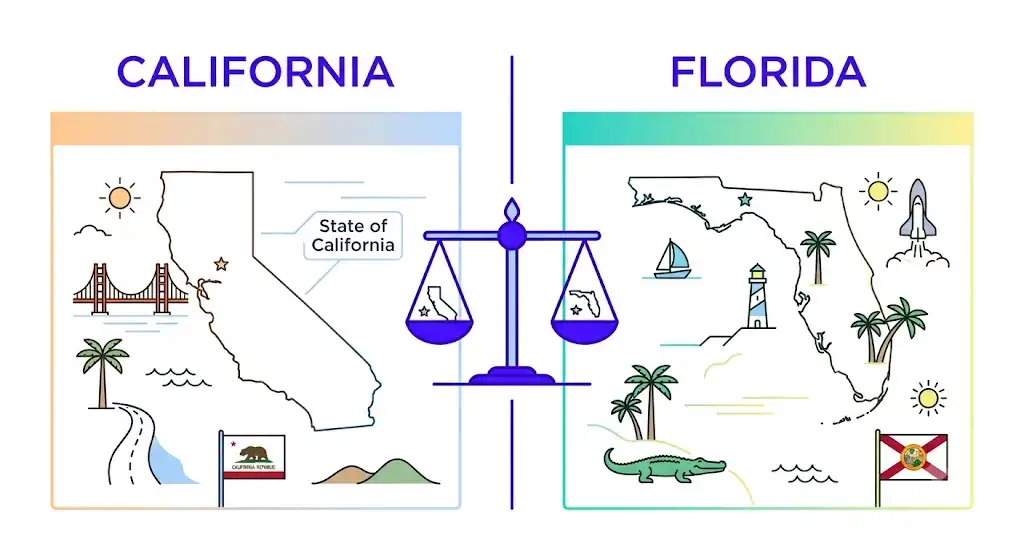
This is where “comparative negligence” comes in, and it’s also where a lot of outdated information is floating around online. If you’ve searched for how California and Florida compare on this issue, you’ve probably seen both described as “pure comparative negligence” states. That used to be true. It isn’t anymore. Florida changed its rule in 2023, and the difference between the two states today is bigger, and more consequential for injury victims, than most articles let on.
California vs. Florida Fault Rules: Key Differences
| California | Florida | |
|---|---|---|
| Type of rule | Pure comparative negligence | Modified comparative negligence (since March 24, 2023) |
| Fault threshold | None, there is no cap on recovery | More than 50% at fault bars recovery entirely (the “51% bar”) |
| How it was established | 1975, Li v. Yellow Cab Co., 13 Cal. 3d 804 (court decision) | March 24, 2023, House Bill 837 (state statute, Fla. Stat. § 768.81) |
| Key exception | None | Medical malpractice claims still use pure comparative negligence |
| Underlying insurance system | At-fault system | No-fault system for injuries (PIP-based) |
| Minimum auto insurance (as of source dates below) | $30,000/$60,000 bodily injury, $15,000 property damage, effective Jan. 1, 2025 (SB 1107) | $10,000 Personal Injury Protection (PIP) and $10,000 Property Damage Liability (PDL); bodily injury liability is not required for most drivers under current registration rules |
Sources for this table: the Florida Senate's official statutes page for Fla. Stat. § 768.81, the FindLaw case archive for Li v. Yellow Cab Co., the California DMV's insurance requirements page, and Florida's Motor Vehicle No-Fault Law (Fla. Stat. § 627.736) as summarized by licensed-agent industry sources. Full citations are in the Research & Sources section below. Note that Florida's no-fault minimum coverage framework has been the subject of proposed legislative changes; readers should confirm current requirements directly with the Florida Department of Highway Safety and Motor Vehicles before relying on any specific dollar figures.
How Comparative Negligence Affects Your Claim
Comparative negligence is the legal framework a state uses to divide financial responsibility when more than one person contributed to an accident. Instead of asking “who caused this,” the system asks “how much did each person’s actions contribute to this,” usually expressed in percentages that add up to 100.
There are generally three approaches used across the United States:
- Pure comparative negligence. An injured person can recover damages no matter how much fault they share, even if they were 99% responsible. Their compensation is simply reduced by their own percentage of fault.
- Modified comparative negligence. An injured person can recover damages only up to a certain fault threshold, usually 50% or 51%. Cross that line, and they recover nothing.
- Contributory negligence. A small handful of states still use this older, harsher rule, where being even 1% at fault can bar recovery entirely.
California and Florida used to sit in the same category. As of March 2023, they don’t.
California Rule: You Can Recover Money Even if Mostly at Fault
California has used pure comparative negligence since 1975, when the California Supreme Court decided Li v. Yellow Cab Co. (see the Real Case section below). Nothing about that core rule has changed since. Under California law, an injured person can recover compensation even if they were mostly at fault for their own accident. Their damages are reduced by their own fault percentage, but they are never barred outright.
So if a jury or insurance adjuster in California decides you were 80% at fault for a crash and your total damages were $100,000, you could still recover $20,000. That might feel unintuitive, but it reflects a specific policy choice: California’s courts decided that a rigid all-or-nothing rule was less fair than dividing responsibility proportionally, even in lopsided cases.
This matters for insurance dealings too. California requires drivers to carry liability insurance, and as of January 1, 2025, the state’s minimum bodily injury and property damage limits increased under Senate Bill 1107, as confirmed on the California DMV’s insurance requirements page. Minimum coverage and fault percentage are two separate issues, but adjusters frequently raise both at the same time when they’re trying to minimize what they pay out.
Florida Rule: How the 51% Fault Cutoff Can Wipe Out Your Claim
This is the part that trips people up. For decades, Florida also used pure comparative negligence. That changed on March 24, 2023, when Florida enacted House Bill 837, a sweeping tort reform package. HB 837 replaced Florida’s pure comparative negligence rule with a modified comparative negligence system, codified in Florida Statutes Section 768.81. You can read the current text of that statute directly on the Florida Senate’s official statutes page.
Under the new rule, an injured person in Florida can still recover damages if they’re found to be 50% or less at fault, reduced proportionally. But if they’re found to be more than 50% at fault, meaning 51% or more, they recover nothing at all. Florida injury attorneys commonly refer to this as the “51% bar.” There’s one notable exception: medical malpractice claims in Florida are still governed by the old pure comparative negligence standard, since HB 837 specifically carved those cases out.
The timing matters. The new modified rule applies to negligence causes of action that accrued on or after March 24, 2023. Accidents that happened before that date are generally still evaluated under the older pure comparative negligence standard, so the date of the incident, not the date a claim gets filed or resolved, is usually what determines which rule applies. Anyone unsure which standard applies to an older Florida claim should raise that question directly with a licensed Florida attorney, since the accrual date can get legally complicated in some fact patterns.
How Your Fault Percentage Lowers Your Payout
Once you understand that Florida added a hard cutoff and California didn’t, a lot of what happens after a crash starts to make more sense.
Immediately after the accident. In both states, how a scene is documented, who admits what, and what witnesses say can all become evidence used later to argue over fault percentage. In Florida, that argument now carries much higher stakes, because tipping over 50% doesn’t just shrink a settlement, it can erase it.
During medical treatment. Neither state’s fault rule changes what medical care someone should get. But insurers in both states know that treatment gaps or inconsistent statements to providers can be used to argue for a higher fault percentage against the injured person, which matters more under Florida’s system than California’s.
When bills start arriving and income is missed. This is usually when people first start negotiating with insurance adjusters. In California, an adjuster might try to push someone’s assigned fault percentage up to 40% or 50% to shrink a payout, knowing the claim still survives either way. In Florida, an adjuster has a much stronger incentive to argue for 51% or more, because doing so can end the claim’s value entirely rather than just reducing it.
During settlement negotiations or litigation. Both states allow juries or adjusters to assign fault to multiple parties, including other drivers, employers, or property owners. California’s system spreads that fault proportionally without a cliff edge. Florida’s system means both sides are effectively negotiating around a single, high-stakes number: is the injured person at 50% or at 51%.
For a broader look at every state using this threshold rule, see our guide on modified comparative fault and the 51% rule by state.
4 Ways Insurance Adjusters Try to Shift Fault onto You
Adjusters know exactly how much a few percentage points can be worth, and in Florida, they know a shift from 50% to 51% can end a claim outright. A few tactics show up often enough to be worth knowing before you talk to one:
Recorded statements taken early, before you’ve reviewed the accident. An adjuster may ask open-ended questions designed to get you speculating about speed, distance, or timing. Guesses stated as fact can later be used to argue you contributed more to the accident than the evidence actually supports.
Framing questions around what you “should have” done. Phrases like “could you have braked sooner” or “did you see the other car coming” are often less about gathering facts and more about getting you to agree, on the record, that you had an opportunity to avoid the crash.
Pointing to gaps or inconsistencies in medical treatment. If you delayed seeing a doctor or gave a provider a slightly different account of how the accident happened, an adjuster may use that inconsistency to argue your injuries are unrelated to the crash, or that your own conduct after the accident contributed to their severity.
Citing minor traffic infractions, even unrelated ones. A late lane change, a slightly rolled stop sign a block earlier, or a technical equipment violation can be raised to argue for a higher fault percentage, even when it had little or nothing to do with causing the collision.
None of this means every adjuster is acting in bad faith. Insurance companies are businesses, and part of an adjuster’s job is evaluating liability in a way that protects the company’s exposure. Understanding that going in just means you’re less likely to be caught off guard.
4 Steps to Challenge an Unfair Fault Percentage
Being told you’re 40%, 55%, or 51% at fault is not the end of the conversation, it’s usually the opening position. A few concrete steps matter here:
- Ask the adjuster to explain, in writing, how they arrived at that number. A specific fault percentage should be tied to specific evidence, not a general impression of the accident.
- Request a copy of the police report and any witness statements. Compare them against what the adjuster is claiming. Discrepancies are common, and they’re easier to challenge with the documents in hand.
- Gather your own evidence if you haven’t already. Photos of the scene, dashcam footage, traffic camera requests, and independent witness contact information can all shift a fault determination.
- Get a second opinion before accepting a number or a settlement offer. A licensed personal injury attorney in your state can review the same facts and tell you whether the assigned percentage is reasonable or worth disputing, particularly in Florida, where the difference between 50% and 51% is not a rounding error, it’s the entire value of the claim.
Case Example: How Fault Math Changes Your Payout
Imagine two drivers, “Driver A” and “Driver B,” collide at an intersection where the traffic signal timing is disputed. An insurance investigation and later a lawsuit conclude that Driver A was 55% at fault for entering the intersection too late, and Driver B was 45% at fault for going slightly over the speed limit. Driver B’s total documented damages, medical bills, lost wages, and vehicle repair, come to $80,000.
If this accident happened in California, Driver B could still recover 55% of that amount, since California doesn’t cut off recovery no matter how the fault splits. That would put Driver B’s recovery at $44,000.
If this same accident happened in Florida, after March 24, 2023, Driver B would still recover, because 45% fault falls at or below the 50% threshold. Driver B’s damages would similarly be reduced by their own 45% share.
Now change the numbers slightly. Say Driver B is instead found 52% at fault. In California, Driver B could still recover 48% of their damages. In Florida, Driver B would recover nothing, because crossing the 50% line under the modified rule eliminates the claim entirely. This is a hypothetical built only to illustrate the mechanics, not a description of any real case or real parties.
Case Law: Where California’s Pure Fault Rule Began
California’s pure comparative negligence rule isn’t just a statute, it came from a specific, well-documented California Supreme Court decision: Li v. Yellow Cab Co. of California, 13 Cal. 3d 804 (1975). The case arose from a car accident in which the plaintiff, Nga Li, attempted to cross several lanes of traffic and was struck by a taxi driven by a Yellow Cab Company employee who was found to be speeding. Both drivers were found negligent to some degree.
Under the older contributory negligence rule that California used at the time, Li’s own negligence, however small, would have barred her from recovering anything. The California Supreme Court rejected that outcome as unjust and adopted “pure” comparative negligence instead, ruling that fault should be apportioned in direct proportion to each party’s responsibility, no matter how large or small. You can read the court’s original opinion through FindLaw’s archived record of the decision. That 1975 ruling is still the foundation of how fault gets divided in California injury cases today.
What this means for the road ahead in your claim
If you’re dealing with an accident right now, the practical takeaway depends heavily on which state you’re in. In California, a higher fault percentage assigned to you shrinks your recovery, but it generally doesn’t erase it. In Florida, since March 2023, the number 50 isn’t just a data point, it’s a wall. Getting pushed from 50% to 51% fault by an adjuster or a jury can be the difference between a real settlement and nothing.
That’s part of why understanding your state’s specific comparative fault rule, not just a generic national explanation, matters before you sign anything, accept a settlement offer, or agree to a recorded statement with an insurance adjuster. For a broader look at how state law affects your claim more generally, see our State Laws guide, and if you want to understand how a fault percentage translates into an actual settlement number in either type of state, our guide on compensation and settlements walks through how adjusters and attorneys typically calculate that math.
If an insurance company has assigned you a fault percentage you believe is wrong, particularly one anywhere near Florida’s 50% line, it’s worth having a licensed attorney look at the specifics of your case before you accept a number or a settlement. You can reach out through our contact page to get connected with next steps.
Research & Sources
- Florida Senate, Official Florida Statutes, Chapter 768, Section 81, Comparative Fault: https://www.flsenate.gov/laws/statutes/2024/768.81
- Holland & Knight, “Florida Enacts Major Tort Reform and Bad-Faith Insurance Claim Legislation”: https://www.hklaw.com/en/insights/publications/2023/03/florida-enacts-major-tort-reform-and-bad-faith-insurance-claim
- Jimerson Birr, “Florida Makes Major Changes to Comparative Negligence Law”: https://www.jimersonfirm.com/blog/2023/05/florida-tort-reform-bill-hb837-comparative-negligence/
- Florida House of Representatives, CS/CS/HB 837 Staff Analysis: https://www.flsenate.gov/Session/Bill/2023/837/Analyses/h0837z.CJS.PDF
- FindLaw, Li v. Yellow Cab Co. of California, 13 Cal. 3d 804 (1975), full opinion: https://caselaw.findlaw.com/court/ca-supreme-court/1830713.html
- Wikipedia, “Li v. Yellow Cab Co.,” for basic case citation details (13 Cal.3d 804; 532 P.2d 1226, decided March 31, 1975): https://en.wikipedia.org/wiki/Li_v._Yellow_Cab_Co.
- California DMV, “Auto Insurance Requirements”: https://www.dmv.ca.gov/portal/vehicle-registration/insurance-requirements/
- Florida Statutes, Section 627.736, Florida Motor Vehicle No-Fault Law, and industry summaries of current PIP/PDL minimum requirements (used for the comparison table’s Florida insurance figures; verify current amounts directly with FLHSMV before publishing, since proposed changes to Florida’s no-fault framework have been reported but were not independently confirmed via an official government source at the time of writing)
FAQs
Does Florida still use pure comparative negligence at all?
Only in one narrow area: medical malpractice claims. HB 837 specifically kept the old pure comparative negligence standard for medical negligence cases while switching general negligence claims, including most car accident and slip and fall cases, to the new modified system.
Which accidents are covered by Florida’s new 51% rule?
The modified rule applies to negligence causes of action that accrued on or after March 24, 2023. This generally covers car accidents, premises liability and slip and fall claims, and most other negligence-based injury cases, aside from the medical malpractice exception.
Can I still recover something in California if I was mostly at fault?
Yes. California’s pure comparative negligence rule does not have a fault ceiling. Even a plaintiff found 90% or more at fault can still recover the remaining percentage of their damages, though the practical size of that recovery may be small.
Does having more insurance coverage change how fault is decided?
No. Insurance minimums and comparative negligence rules are separate legal concepts. How much coverage a driver carries affects how much money is available to pay a claim, not how fault gets divided between the parties.
If my accident happened in Florida before March 24, 2023, which rule applies?
Generally, the older pure comparative negligence standard still applies to claims that accrued before that date. Because accrual dates can raise complicated legal questions in some situations, anyone with an older Florida claim should confirm this with a licensed attorney rather than assume.
Why did Florida make this change in the first place?
Florida lawmakers passed HB 837 as part of a broader tort reform package aimed at reducing large civil verdicts and reshaping several areas of negligence and insurance law at once. The shift to modified comparative negligence was one part of that larger bill.
Is a 50/50 fault split treated the same in both states?
No. In California, a 50/50 split simply means each party recovers half of their damages from the other, with no special cutoff at that number. In Florida, being found exactly 50% at fault still allows recovery, but crossing to 51% or higher eliminates it entirely, so the practical stakes around that number are much higher in Florida.
Not legal or medical advice: This article is for general educational purposes only and does not constitute legal or medical advice. Comparative negligence rules, statutory deadlines, and exceptions (such as Florida's medical malpractice carve-out) can be fact-specific and may change. If you've been injured in an accident, consult a licensed attorney in your state and a qualified medical provider about your specific situation.
